At the China National Silk Museum in Hangzhou, a major retrospective traces the Chinese couturier’s development through nine collections, from sculptural embroidery and architectural silhouettes to her reinterpretations of imperial dress.
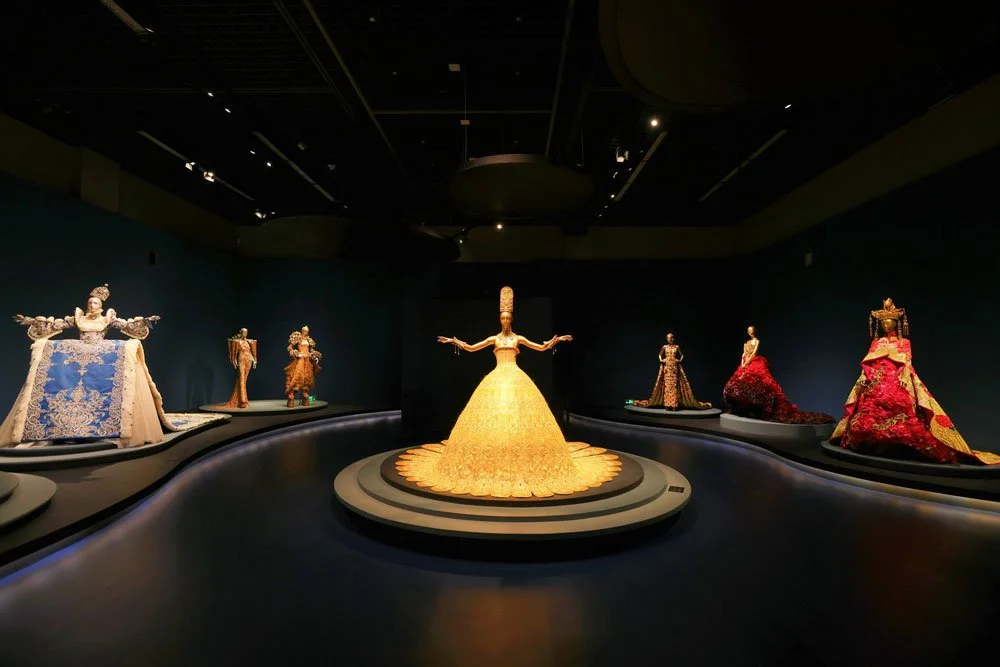
Guo Pei has spent four decades developing a couture practice rooted in Chinese craftsmanship, complex silhouettes and labour-intensive embroidery. Garden of Ethereal Realms: Guo Pei Costume Art Exhibition, running until 31 August 2027, brings together more than 170 works that showcase her use of embroidery, textile manipulation and sculptural construction.
In Guo’s couture, construction determines the silhouette. Layered fabrics and internal supports allow skirts to extend beyond the body, while dense embroidery can give a garment both weight and a pronounced surface. In some pieces, the needlework becomes part of the design’s structure, shaping how the finished garment looks and holds its form.
Guo founded her Beijing couture house, Rose Studio, in 1997, after a decade designing for the Chinese garment industry. She had already worked on a major national commission, designing the ceremonial uniforms for the 2008 Beijing Olympic Games. Her own collections developed a different line of enquiry, drawing on Chinese history, mythology and European architecture.
International attention followed in 2015, when Rihanna wore Guo’s yellow embroidered cape gown to the Met Gala, themed China: Through the Looking Glass. The appearance introduced many viewers to a designer whose work extended well beyond the red carpet. In 2016, Guo became the first Chinese designer invited to join the Chambre Syndicale de la Haute Couture as a guest member, enabling her to present collections within the Paris couture calendar. Her work continues to be produced by the specialist teams at her Beijing atelier.
Time, Fable, Rebirth
The exhibition opens with Samsara, One Thousand and Two Nights and The Story of the Dragon, collections in which narrative and cultural symbolism shape the garments.
Presented in 2005, Samsara takes the cycle of life as its starting point, moving through birth, growth and maturity. One Thousand and Two Nights, shown in 2009, draws on the layered storytelling of the Arabian Nights, with women’s emotional lives and experiences of adversity informing its imagery. Both collections use elaborate surfaces and silhouettes to give their themes physical form.
The Story of the Dragon, from 2012, centres on one of China’s most enduring symbols. Guo developed several approaches to the motif, including openwork forms and raised, padded embroidery that gives the dragon a relief-like surface. The technique lends the figure depth and volume, making the embroidery itself a defining feature of the garment. The collection demonstrates how Guo adapts traditional imagery through the specialist techniques of her atelier. <Cite refs={["turn672381search14","turn672381search16"]}/>
Building Dreams, Legend
The second section brings architecture into focus through Legend and Architecture. Both collections draw on buildings and decorative arts, but translate them into clothes in different ways.
Presented in spring 2017, Legend developed from Guo’s encounter with the architecture and decorative arts of St Gallen, Switzerland. Working with textile manufacturer Jakob Schlaepfer, she developed bespoke fabrics informed by the murals of the city’s cathedral and its Rococo ornament. Three-dimensional embroidery and handcrafted copper accessories added further complexity to the garments.
In its review of the collection, Couture Notebook noted the use of phosphorescent fabric, metallic fibres and elaborate embroidery. The opening look, The Revenant, used luminous fabric to create an otherworldly effect, while the finale was a scarlet robe woven with metal fibres. The collection’s references to European architecture were carried through its materials and surfaces, developed using the handwork central to Guo’s practice.
Architecture, presented in Paris for autumn/winter 2018, drew on Gothic buildings, with their pointed spires, vaulted arches and stained-glass windows. Guo translated these forms into geometric lines and exaggerated silhouettes. Panniers provided the foundation for skirts with curved extensions and layered planes, giving the clothes the volume needed to sustain their architectural shapes.
As Couture Notebook observed in its review, the pannier was central to the collection’s construction: it allowed the fabric to extend beyond the body and hold its shape. The result was a series of garments in which the underlying framework was as important as the surface decoration.
Dream Isle Garden
Childhood imagery, flowers and fantastical creatures inform the third section, which includes Children’s Dream, Heart’s Garden and Paradise Island.
Children’s Dream, from 2008, uses pastel colours, high waists and folded forms to evoke childhood play and the construction of paper objects. Heart’s Garden, presented in 2015, takes flowers as its central motif, drawing on their associations with growth and renewal.
Paradise Island, shown in 2018, draws on Elysium, the mythological abode of the blessed. Guo populated the collection with flowers and fantastical creatures, translating the imagined landscape into elaborate gowns. In its review, Couture Notebook described a presentation built around a reflective black stage and a sculptural tree-root installation by French paper artist Charles Macaire. The clothes extended that setting through embroidery, floral ornament and unusual materials, including bamboo woven in Huangshan, Anhui.
The collection gave Guo scope to develop her interest in textile experimentation and handwork beyond conventional eveningwear. Flowers were used to shape the garments as well as decorate them, with embroidery and accessories contributing to the fantasy of the presentation.
Eastern Palace Echoes
The final section draws on Chinese mythology, imperial architecture and historical dress, with the East Palace collection, presented in 2019, as a central reference.
Inspired by images of the moon palace and dragon palace, the collection incorporates auspicious animals and other motifs from Chinese mythology. Wide sleeves, crossed collars and long robes recall traditional forms of dress, while contemporary tailoring alters their proportions. Mother-of-pearl inlay and elaborate embroidery add further detail.
Guo’s approach to historical dress is evident here. Traditional silhouettes and decorative techniques provide a starting point for new forms, with the scale of couture allowing her to exaggerate proportions and develop more complex construction. The garments retain recognisable elements of Chinese dress without reproducing historical costumes intact.
For a designer whose work depends so heavily on embroidery and the manipulation of fabric, the China National Silk Museum is a fitting host. The museum’s focus on silk, textiles and the history of dress places Guo’s contemporary practice within a longer tradition of Chinese textile making. Hangzhou’s association with silk adds a local context to the exhibition.
A folded-paper installation also appears in the exhibition, translating the folds and layers of couture into a three-dimensional form. It draws attention to the relationship between material and structure that runs through Guo’s work.
Seen across four decades, the collections show how she has adapted different cultural references to the demands of couture. A dragon, a Gothic cathedral and an imperial robe each lead to a different set of forms and techniques. What connects them is Guo’s insistence that the garment itself carry the idea, through the way it is cut, constructed and embroidered.